

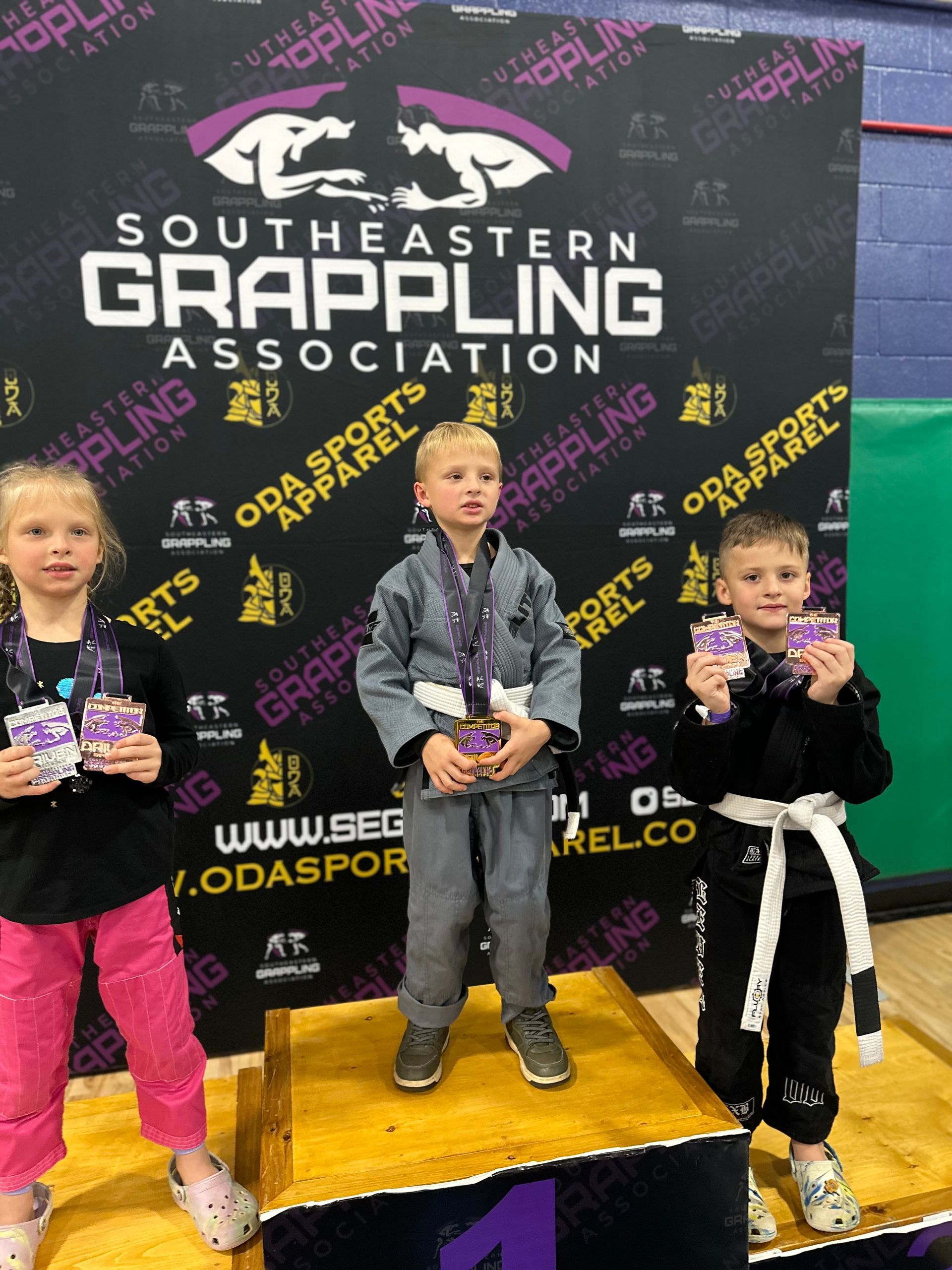
Jiu-Jitsu is one of the simplest ways to train your body and your attention at the same time, without needing a perfect starting point.
Most people come to Jiu-Jitsu for one clear reason: they want to feel better in their body. In Asheville, that usually means better everyday fitness, less stress, and a training routine that actually sticks when life gets busy. We see it all the time, and it is why we teach the way we do.
Jiu-Jitsu is also sneakily practical for focus. You cannot drift through a round thinking about email. You are solving a moving problem with your whole body, and that kind of full attention tends to spill over into work, school, and family life in a good way.
Nationally, interest in Brazilian jiu-jitsu has risen sharply over the last two decades, and that tracks with what we notice on the mats: more adults want a training plan that is challenging, measurable, and not just another treadmill session. If you are looking for Jiu-Jitsu in Asheville, our goal is to give you a place where progress feels real, week to week.
Why Jiu-Jitsu builds focus faster than most workouts
Focus is not a personality trait. It is a skill, and like any skill it gets sharper when you practice it under the right pressure. Jiu-Jitsu creates that pressure in a controlled way. You are constantly making small decisions about posture, balance, grips, breathing, and timing, and you get immediate feedback.
The best part is that the feedback is honest. If your attention slips, a position falls apart. If you rush, you give up space. When you slow down and see what is happening, you start solving problems instead of reacting to them. That is focus training, just packaged as a martial art.
The problem solving loop that trains your brain
Every round has a simple loop: notice, decide, act, adjust. We coach you to stay inside that loop instead of panicking or freezing. Over time, you start recognizing patterns. You stop wasting energy on guesses and start making cleaner choices.
This is one reason Jiu-Jitsu feels so satisfying compared to random workouts. You are not just sweating. You are learning. And learning tends to keep people consistent.
A calmer nervous system through controlled intensity
A lot of adults carry around low-grade stress all day. Jiu-Jitsu gives you a safe place to feel intensity and then come back down. You practice breathing under pressure, relaxing your shoulders, and letting your hips move instead of bracing.
That calm carries over. It shows up as better patience in traffic, clearer thinking in meetings, and a little more capacity at home. It is not magic. It is repetition.
Everyday fitness you can actually use
We like “functional” fitness, but we also know the term gets overused. Here is what we mean: you should be able to move well, recover well, and feel capable in normal life. Jiu-Jitsu is full-body work that rewards good movement, not just brute force.
You will use your legs for base, your hips for power, your core for stability, and your upper body for frames and grips. Because positions change constantly, you are training coordination and endurance at the same time. The sessions tend to feel like interval training, but with a purpose.
Strength that comes from leverage, not strain
If you have ever tried to muscle through something and felt your neck and lower back complain, you already understand why we emphasize leverage. Jiu-Jitsu works best when your skeleton is stacked and your weight is placed correctly.
We teach you to build frames, manage distance, and use your hips. That means you can train hard without feeling like every round is a tug-of-war. As technique improves, many students notice their joints feel better, not worse.
Cardio that does not feel like “cardio”
Rolling has a rhythm: bursts of effort, moments of control, then another burst. Your heart rate goes up and down, and your body adapts. It is a kind of conditioning that feels more like playing a game than running laps.
If your goal is fat loss, energy, or general stamina, this matters. You keep showing up because the training stays interesting.
What a typical class feels like on the mat
People worry about walking into a martial arts class and feeling lost. We keep the structure predictable so you can relax and learn. Most classes follow a simple flow: warm-up that supports movement quality, technical instruction, drilling to build timing, and live rounds scaled to your level.
We also pay attention to the room. The vibe should be focused but friendly, and safety is part of the culture. You can train seriously without feeling like you have to prove something.
Here is what you can expect as you settle into our program:
• Clear coaching cues that help you fix one or two things at a time instead of getting flooded with details
• Progressive training intensity so you can build conditioning without burning out in week one
• Practical positional goals, like escaping bad spots and holding strong positions, before chasing flashy moves
• Partner selection that matches size, experience, and comfort level so learning stays productive
• A pace that respects that you have work, sleep, and responsibilities outside the academy
That structure is also why Jiu-Jitsu works for busy adults. When the class is consistent, you can measure improvement even if you only train a couple days per week.
The “secret” to faster progress: positional confidence
Many beginners think progress is about collecting techniques. In reality, progress is about being less overwhelmed. We focus on positional confidence first, because it makes everything else easier.
Positional confidence means you know what to do when things go wrong. You recognize common problems, and you have a few dependable answers. When you stop feeling stuck, your focus improves automatically, because your brain is not scrambling.
Why we start with escapes and control
We would rather you feel safe and capable than “advanced.” Escapes build resilience and reduce panic. Control positions teach you how to stabilize your weight and breathe. Once those are in place, submissions become more natural and, honestly, more responsible.
This approach also supports self-defense, even when your main goal is fitness. If you can manage distance, stand up safely, and control positions on the ground, you have tools that matter.
Kids Jiu-Jitsu in Asheville: focus, confidence, and healthy energy
If you are looking into kids Jiu-Jitsu in Asheville, you probably care about more than exercise. You want your child to listen, follow directions, and handle frustration better. We build our kids program around those real-life skills, with movement and fun as the delivery system.
Kids learn boundaries fast on the mat. There are rules, partners, and consequences that are immediate but safe. Over time, that helps many kids improve impulse control and attention span, especially when parents stay consistent with attendance.
What kids practice that helps outside class
We coach kids to do a few things really well: keep hands to themselves unless training, make eye contact when receiving instructions, and reset quickly after mistakes. Those sound simple, but they stack into confidence.
We also keep an eye on age-appropriate expectations. Some kids need more structure. Others need more challenge. The goal is steady growth, not pressure.
Adults who hate the gym usually love this
Some people in Asheville love hiking and still hate gyms. We get it. Rows of machines can feel isolating, and it is easy to quit when you are bored. Jiu-Jitsu tends to solve that problem because you are training with partners, learning skills, and getting small wins every session.
You do not need to be “in shape” first. Training is how you get in shape. The first weeks are mostly about learning how to move, how to tap early, and how to leave your ego at the door. After that, it starts to click.
How we keep training sustainable
Consistency beats intensity, especially for adults with real schedules. We encourage you to train at a pace that supports recovery. That might mean two classes a week at first. It might mean adding a third day once your body adapts.
We also talk openly about common sore spots: hands, neck, hips. Small adjustments in posture and grip selection can make a huge difference. You should leave class tired, sure, but also like you could come back tomorrow if you needed to.
A simple path to get started and stay consistent
Motivation is unreliable. A plan is better. If you want Jiu-Jitsu in Asheville to become part of your routine, we recommend a simple progression that does not require a massive life overhaul.
1. Pick two training days you can protect most weeks, even when work gets hectic
2. Show up early enough to settle your breathing and ask one quick question
3. Focus on one theme per month, like escapes, guard retention, or takedown entries
4. Track one measurable win weekly, like lasting longer in a position or escaping once per round
5. Deload when needed by drilling more and rolling lighter instead of disappearing for weeks
This is also where wrestling concepts help, even if you have never wrestled. Stand-up skills, balance, and pressure make your overall game cleaner, and current competition trends show takedowns matter more than ever. We bring that mindset into training in a way that is approachable for beginners.
Take the Next Step
Building focus and everyday fitness does not require perfection, but it does require a practice you can repeat. Our classes are designed to help you think clearly under pressure, move better in your real life, and enjoy the process enough to keep coming back.
When you are ready, we would love to show you how we teach at Speakeasy Jiu-Jitsu & Wrestling Academy, whether your goal is adult training, kids Jiu-Jitsu in Asheville, or simply finding a smart way to start Jiu-Jitsu in Asheville and stay consistent.
Train consistently and see measurable progress by joining a Brazilian Jiu-Jitsu class at Speakeasy Jiu-Jitsu & Wrestling Academy.