

Jiu-Jitsu gives you a practical way to get stronger, think clearer under pressure, and find your people in Asheville.
Starting something new as an adult can feel strangely vulnerable, even when it is something you genuinely want. Jiu-Jitsu is no exception. You show up, you tie a borrowed belt, and suddenly you are learning how to move your body in ways you have never had to think about before.
Our beginner-friendly approach to Jiu-Jitsu in Asheville is built around a simple idea: you should feel safe, supported, and challenged in the right dose. We take the mystery out of the first few weeks by teaching fundamentals clearly, repeating them often, and helping you understand why each detail matters, not just what to do.
If your goal is fitness, self-defense, stress relief, or simply doing something real with real people, you can start exactly where you are. You do not need to be in shape first. You get in shape by training. And you do not need confidence first, either. You build it, one class at a time.
Why Jiu-Jitsu clicks for beginners in Asheville
Asheville is full of people who like learning skills, staying active, and finding community that does not feel forced. Jiu-Jitsu fits that culture well because it is hands-on, mentally engaging, and humble in the best way. You can have a great workout, learn something useful, and leave class feeling a little lighter.
One reason beginners stick with Jiu-Jitsu is that progress is visible. In the beginning, you might struggle just to remember where your hands go during a guard pass. Then, a few weeks later, you notice you are breathing more calmly, moving with better balance, and recognizing situations before they happen. That is a real win, and it shows up outside the gym too.
We also like that Jiu-Jitsu gives you options. You can train for self-defense, you can train for competition, or you can train simply because it makes your week better. Our job is to help you keep progressing without burning out.
What you actually learn in beginner Jiu-Jitsu
Beginner training should be structured, not random. We introduce skills in layers so you can build a foundation that keeps working as you improve. The fundamentals matter because they show up everywhere, from your first month to your fifth year.
Movement, posture, and base
Before submissions and fancy transitions, you need to move well. We spend time on posture, base, and simple mechanics like hip movement and safe ways to fall and recover. These are the “invisible” skills that protect you and make everything else easier.
Good posture is also confidence, in a quiet way. When you know how to keep balance and how to frame with your arms and legs, you stop feeling helpless in unfamiliar positions.
Escapes first, then control, then submissions
A beginner who cannot escape will not enjoy training for long. That is why we emphasize escapes early. If you can get out of bad positions, you can relax enough to learn the next piece.
From there, we teach positional control. Control is what lets you slow things down, make good decisions, and avoid relying on strength. Submissions come with time, and when they arrive on top of solid control, they feel clean instead of chaotic.
Live training that fits your level
You will not be thrown into the deep end on day one. We scale intensity based on experience, size, and comfort level. Some days you will drill, some days you will do controlled rounds, and over time you will spar more freely as your timing and awareness improve.
That blend is important because Jiu-Jitsu is a contact sport, but it is also a thinking sport. The goal is progress you can repeat, not one hard night that sidelines you.
A realistic timeline: how long it takes to get good
Most beginners want to know, quietly, how long it will take to feel competent. The honest answer is: you will feel better fast, and you will keep getting better for a long time. Early improvements show up within weeks, especially in conditioning, coordination, and comfort with contact.
Belt progression is a long game. Survey data often puts the average time from white to blue belt at around 2.3 years, with later belts taking longer as the skill level rises. That can sound intimidating, but it is also a relief because you do not have to rush. You get to focus on the process.
We frame progress in small, practical milestones. Can you hold posture in someone’s guard without panicking? Can you escape mount with a clear sequence? Can you keep your breathing steady during a round? Those are the steps that make you “good,” long before any belt color changes.
Safety and injury prevention: what we prioritize from day one
Jiu-Jitsu is extremely rewarding, but it is still a sport with injury risk. A 2019 study reported that 59.2% of BJJ athletes had at least one injury in the prior six months, with novices showing higher injury rates in training than more experienced athletes. We take that seriously because beginners should not have to learn the hard way.
Our safety culture is built into how we teach, how we pair partners, and how we manage intensity. You will hear us talk about tapping early, controlling speed, and protecting training partners as a core skill, not an optional courtesy.
Here are a few habits we coach consistently because they keep you training longer:
• Tap early and without apology, especially on joint locks and neck pressure, because quick taps protect your training time
• Choose control over explosion, since sudden twisting and scrambling is where many preventable injuries happen
• Communicate with your partner before rounds about pace, injuries, and experience level, so both of you can train well
• Focus on position before submission, because stable positions reduce chaotic movement and awkward collisions
• Ask questions between rounds, since small technical fixes can remove a lot of unnecessary strain
If you are coming back from an old injury, we will help you scale training intelligently. Consistency beats intensity, especially early on.
Adult Jiu-Jitsu in Asheville: what a typical class feels like
Adult Jiu-Jitsu in Asheville should feel like the best kind of hard. You will work, you will sweat, and you will also think. Most classes follow a structure that makes learning predictable, even when the techniques are new.
We usually start with a warm-up that supports grappling movement, not just general fitness. Then we teach a technique or a small sequence, and you drill it with a partner. Drilling is where your body learns the pattern. After that, we add resistance with positional rounds or controlled sparring so you can test the skill under pressure.
The vibe matters too. You should be able to train seriously without feeling judged. Beginners ask a lot of questions, and that is normal. Some days you will feel sharp. Other days you will feel like you forgot everything. That is also normal, and it is part of how Jiu-Jitsu works.
Confidence that is earned, not hyped
A lot of people come to Jiu-Jitsu hoping for confidence. What you get is better: proof. You prove to yourself that you can show up tired and still learn. You prove you can stay calm in uncomfortable positions. You prove you can be a beginner at something again, which is a skill most adults do not practice often.
That confidence carries into daily life. You may notice you handle stress differently, or you stand a little taller, or you are less reactive in tense moments. We see it happen over and over, and it is rarely dramatic. It is quiet, steady change.
Self-defense is part of that conversation too. We teach skills that help you manage distance, maintain balance, and control situations when someone is close. Jiu-Jitsu emphasizes leverage and technique, which is why it can be effective for many body types when trained consistently and responsibly.
Community without the awkwardness
Community can be a weird word. Some places try to manufacture it. In Jiu-Jitsu, it tends to happen naturally because you are doing something challenging together, in close contact, with shared rules and shared respect.
Over time, you recognize familiar faces. You learn who rolls light, who rolls technical, who will remind you to breathe. You start cheering for someone’s first clean escape or first controlled round. Those small moments add up, and it becomes one of the best parts of training.
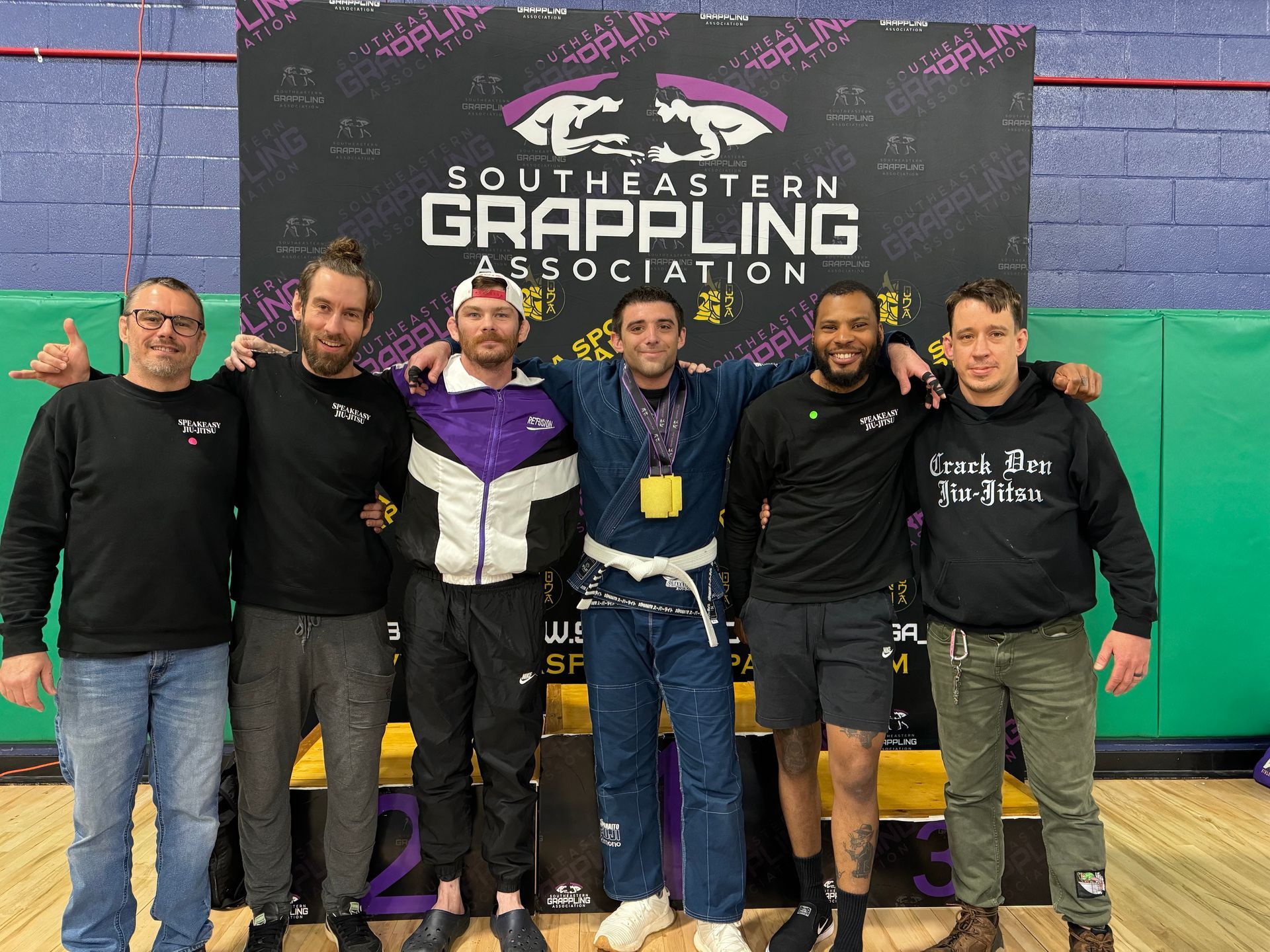
Asheville has a growing grappling scene with tournaments and local events, but you do not have to compete to belong. You can train purely for personal development and still be part of the room.
How to start without overthinking it
If you are interested in Jiu-Jitsu in Asheville but you are stuck on the details, we get it. Beginners tend to worry about gear, fitness level, and whether they will “get it.” The simplest approach is to come in, try a class, and let the first experience answer most of the questions.
Here is what we recommend for a smooth first week:
1. Check the class schedule and pick a beginner-friendly time you can repeat each week, because consistency matters more than cramming
2. Show up a little early so we can get you oriented, answer questions, and help with gear expectations
3. Focus on learning one or two details per class, not everything at once, since early progress is built on repetition
4. Train at a sustainable pace, even if you feel competitive, because your body needs time to adapt to grappling
5. Keep a simple note on what you learned, because small reminders help techniques stick between classes
If you commit to two or three classes a week for a couple months, you will feel the difference in your body and your mindset. That is when Jiu-Jitsu starts to feel less like chaos and more like a language you can speak.
Ready to Begin
If you want beginner Jiu-Jitsu that is structured, practical, and welcoming, we built our training environment for exactly that. At Speakeasy Jiu-Jitsu & Wrestling Academy, we focus on fundamentals, safety, and steady progress so you can build skill and confidence without feeling rushed.
Whether your goal is fitness, self-defense, stress management, or finding a consistent community in Asheville, we will meet you where you are and help you move forward with clear coaching and supportive training partners at Speakeasy Jiu-Jitsu & Wrestling Academy.
Continue your Jiu-Jitsu journey beyond this article by joining a class at Speakeasy Jiu-Jitsu & Wrestling Academy.